
THE TRAINING EDIT - Summer Edition
- MSA & Circus Arts
- 3 hours ago
- 5 min read
How young aerialists, acrobats, and tumblers can stay strong, focused, and connected to movement between classes
By Katia Dmitriyeva, Creative Director.
With insights from MSA Coaches Sabrina Isabella and Regina Meirmanova.
Editor’s Note
Summer changes the rhythm of nearly every family’s schedule. Classes pause, travel begins, and the consistency students build throughout the year can become harder to maintain.
At MSA, we do not see that change of pace as a reason to chase an intensive training schedule—or to abandon movement altogether. Summer can be an opportunity to practice something equally valuable: finding small, realistic ways to stay connected to the body.
This edition features insights from Coaches Sabrina and Regina, who share how they approach busy training seasons themselves, what they recommend to young movers, and what families may not realize about circus training.
Their perspectives are distinct, but the message is remarkably consistent: progress does not require perfect conditions. It begins with a habit manageable enough to continue.
— Katia

The Case for Doing Less—Consistently
Summer training can easily become an all-or-nothing proposition.
Without time for a complete class or workout, it may feel as though a shorter session is not worth doing.
Coach Regina encourages students to lower that threshold:
“Something I always tell students is to try to find 10 to 15 minutes a few times a week to just move your body․ You don't have to do a full workout‚ even just doing some stretching‚ some core work‚ or practicing your body positions is going to be a big help․ Crushing the highest level or training every day is not necessary‚ just keep the body moving and active․ If you stick with it even for a small amount of time‚ you'll come back feeling stronger and more confident for class․”
That small window can be enough to keep familiar movement patterns active and make the eventual return to class feel less abrupt.
Coach Sabrina offers the practical reminder behind that consistency:
“Try to stretch and condition at least a couple times a week. We can lose strength and flexibility easier and quicker than you think-- which is why it's very important to keep up with it.”
The goal is not peak performance throughout the summer. It is maintaining a relationship with movement: a few stretches, a short conditioning sequence, or several focused minutes spent revisiting foundational body positions.

Training With a Destination
Consistency becomes easier when the work is connected to something meaningful.
For Coach Sabrina, that often means thinking beyond the workout in front of her. A future production, a more difficult act, or a new skill gives today’s training a clear destination.
“When things start to feel busy in the moment, too busy to workout or train, I remind myself of long term goals. For example-- I know I want to perform in the MSA show six months from now and I want to have a new, fun, and harder act with exciting tricks. I have to keep building my strength and start working on new tricks now, so that they are ready for the performance.”
That long view is especially useful for young athletes. A brief conditioning session may not feel significant in isolation, but it becomes part of a larger story: returning to class prepared, progressing toward a goal, or eventually bringing a new skill to the stage.
Coach Regina’s approach begins with flexibility rather than perfection:
“When life gets busy, I remind myself that something is always better than nothing. If I don't have time for a full workout, I'll fit in a quick strength session, stretch while reading/studying, or spend a few minutes working on mobility before bed.”
Her perspective offers an important counterbalance to rigid training expectations. Consistency can take different forms during different seasons.
“Progress isn't about having perfect weeks; it's about staying consistent over time and giving yourself grace when life gets hectic.”
No Skill Exists in Isolation
One of the most valuable—and often least visible—parts of circus training is the way different disciplines inform one another. As Coach Sabrina explains:
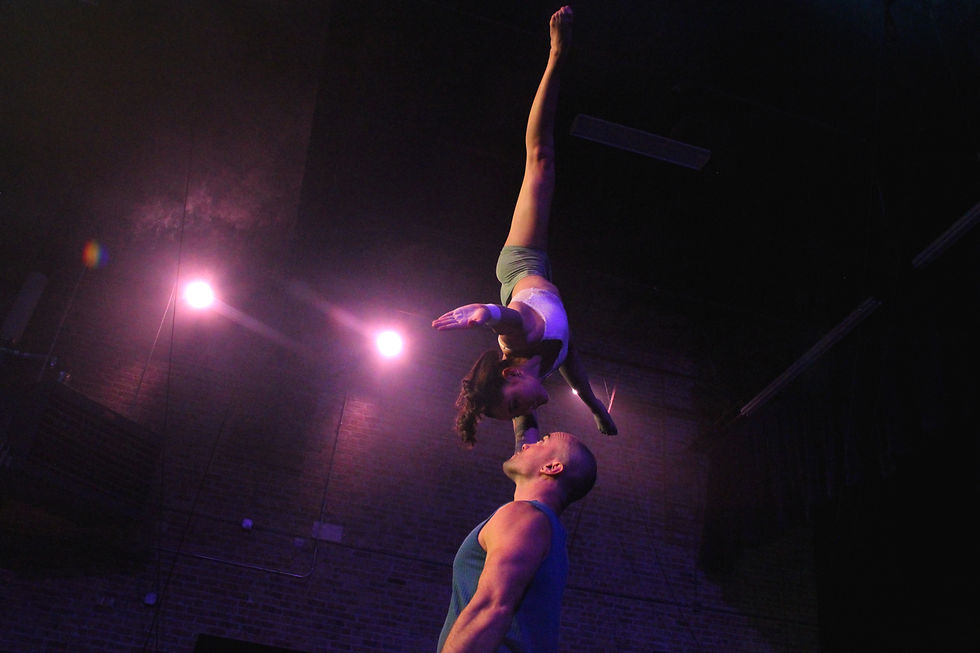
“Many different disciplines go hand in hand. It may not look like it, but tumbling and aerial compliment each other really well. Being able to move and understand your body and certain body shapes/ positions on the ground actually carries over really well in the air. The grace and control you learn in the air/ on any apparatus transfers over really well to tumbling.”

Body awareness developed through tumbling supports control in the air. Shapes first understood on the floor reappear on silks, lyra, and trapeze. Precision developed on an apparatus can later influence movement across the floor.
This is why well-rounded circus training is not simply a collection of unrelated activities. Each discipline gives students another way to understand alignment, timing, coordination, control, and expression.
The result is not only a stronger aerialist or tumbler. It is a more adaptable mover.
Returning Without the Pressure to Be Perfect
The first class after a long break can feel difficult. Muscles may fatigue sooner. Familiar skills may take time to return. That experience is normal—and it does not erase the work that came before it.
Coach Sabrina’s advice is direct:
“If you haven't already, start working out now! The first day back to classes after months off is always hard. Help yourself out by waking up your muscles now.”
Preparation helps, but mindset matters just as much.
Coach Regina encourages students to see mistakes and setbacks as part of the process rather than evidence that they are falling behind:
“Don't be afraid to make a mistake‚ or to have one of those days where you're feeling down․ Every skill you ever learned started with a fall‚ trial‚ and lesson of what went right and wrong․ These setbacks aren't failures; they're simply experiences that will turn you into a stronger‚ more confident athlete․”
Her message reaches beyond summer training. Progress is personal, and the most useful comparison is not with the student beside you.
“Every human being is different‚ so don't try to be as good as someone else․ Try to be a little better than you were yesterday․ Above all‚ have fun because it's summer!”
The 15-Minute Summer Reset
A simple, no-equipment movement break for students—and the whole family.
This routine is designed to be easy to begin and simple to remember.
0:00–2:00 | Wake Up the Body
30 jumping jacks
30 seconds of high knees
10 arm circles forward and 10 backward
10 wrist circles in each direction
2:00–7:00 | Build Everyday Strength
Complete each movement at a steady, controlled pace:
20 squats
20 glute bridges
20 supermans
20 alternating plank shoulder taps
30-second plank hold
Coach Sabrina’s golden number: “My golden number is 20! For every conditioning exercise-- do 20 reps”
7:00–12:00 | Restore Mobility
Hold each position gently.
Low lunge — 30 seconds per side
Pike stretch — 30 seconds
Straddle reach — center, right, and left
Splits — 30 seconds per side
Slowly roll the shoulders and shake out the arms
12:00–15:00 | Body Shapes, Balance, and Reset
Hollow-body hold — 30 seconds
Arch or superman hold — 30 seconds
Balance on one foot — 30 seconds per side
Finish with three slow breaths
The objective is not exhaustion. It is to finish feeling more awake, connected, and ready to move again.
Want a Longer Training Session?
Explore Coach Regina’s full 20–30 Minute At-Home Circus Training Plan, featuring an extended warm-up, stretching sequence, conditioning exercises, and cooldown.
For students who benefit from more structure, MSA also offers youth circus arts programs options throughout the year.
Join the Conversation
What helps your family stay active when schedules get busy?
A quick 10–15 minute home routine
A scheduled class, camp, or practice
Outdoor movement and family activities

The Training Edit is part of In the News, MSA & Circus Arts’ editorial series featuring coach insights, student stories, and expert perspectives from the Midwest’s premier destination for circus arts education.
Photography: Tatiana Zharskaya, Grace Gershenfeld, and the MSA Media Team
